
In September 2002, at Whitemoor Haye gravel quarry in Staffordshire, digger driver Ray Davies spotted something unusual in his bucket. It turned out to be the front end of a middle-aged woolly rhinoceros. These huge, 1.5 tonne creatures became extinct some 12,000 years ago, probably because they couldn’t cope well with severe cyclic climate change (up to 7ºC in a thousand years) and the hunting activities of early humans. Academics like to give names to such finds.
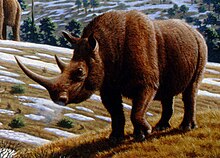
A woolly rhinoceros said,
“I think before long I’ll be dead,
For I can’t stand these changes
In temperature ranges;
It’s messing up things in my head.
“We rhinos like climate stability:
We have poor adaptive ability –
We’re built for the cold.
I’m not very old,
But I’m starting to feel my fragility.”
But the climate refused to deliver,
So the rhino expired with a shiver.
Quick-frozen he lay
Out of predators’ way,
By a braided periglacial river. . .
In a quarry at Whitemoor Haye,
A JCB driver called Ray
In 2002
Caused a hullabaloo
When he looked in his bucket one day.
He had dug up that rhino’s front end!
Academics began to descend
To share in his fame,
And they thought up a name
For their woolly rhinoceros friend.
After pondering day after day
In their quaint, academical way,
They cried with one voice,
“There is no other choice:
The name of our rhino. . . is Ray!”